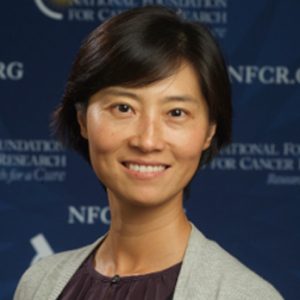
As an essential component of all living cells, conserved in evolution, are aminoacyl-tRNA synthetases (aaRS), a family of enzymes that catalyze the first step reaction in protein synthesis. Dr. Xiang-Lei Yang joins NFCR-sponsored scientist Dr. Paul Schimmel as leaders in aaRS research and in discoveries that these ancient enzymes also have other vital, yet unexpected biological roles that can lead to promising therapeutic strategies.
Dr. Yang’s recent research focuses on the aaRS enzyme, SerRS, which brings the amino acid Serine to proteins during synthesis. Her team discovered SerRS also regulates and inhibits blood vessel growth or angiogenesis. For tumors to thrive and grow, they require their own blood vessels to provide essential oxygen and nutrients. Dr. Yang’s team determined that SerRS interacts with and inhibits c-Myc, one of the most significant cancer-causing or oncogenes upregulated in many types of cancers. c-My controls downstream genes including the gene for key blood vessel growth factor, VEGF. By inhibiting the expression of VEGF, tumor blood vessel formation is shut down, starving tumors of nutrients. In addition, the scientists discovered that SerRS regulates many immune system-related molecules.
Dr. Yang’s team is exploring this critical area of research in triple negative breast cancer using laboratory models and patient breast cancer samples, both from primary and metastatic cancer sites. They found the expression of SerRS positively correlates with greater survival in breast cancer patients and, SerRS is significantly downregulated during metastasis, suggesting SerRS is a suppressor of breast cancer and its metastasis. Similar findings of SerRS expression has been found in tissue samples of brain, esophageal, kidney (clear cell), rectal, stomach, and thyroid cancers. Their significant research may lead to novel therapeutic applications for these cancers.